Ardoberg-Holstein

Ardoberg-Holstein

Thursday, December 15, 2016

The Mask of Aksoum


It was in December of 1866 that I arrived in Zanzibar. I had been contacted by the correspondent of the Paris Charade magazine, Georgio Snufalufigos. He knew I would be passing  through that port on my journey back to Paris and he wished me to carry his account of a mysterious expedition he hoped to complete before I arrived.  On the appointed day and time I entered  the Cafe European to meet my friend. He wasn’t there but the barkeep directed me to a stranger sitting in a dark corner who had been upcountry with Georgio.  I approached and introduced myself to the stranger, explaining my agreement with Georgio. He shrugged and pushed a chair out with his foot by way of welcome. He was gaunt and hollow eyed and already drunk, while it was not yet 2 PM.  
Bentley Speedicut takes the field
The man’s name was Bentley Speedicut and he was one of those English gentlemen who inherited a great deal of money, allowing him the freedom to wander the dark places of the earth for the purpose of enhancing his status and reputation at home. This Speedicut had heard from the Arabs, tales of an ancient ruined city in the hills above Lake Tanganyika. He set about organizing a small expedition to the area, hoping to be the first European to explore the site, and perhaps pick up a few shiny objects for his trouble. Georgio heard of his plan and offered to chronicle his exploits and make him famous. The expedition, Speedicut, Georgio a few porters to carry trade goods to barter for food along the way and twenty tough looking young Ruga Ruga mercenaries, set off for the interior in the Spring.
The tribesmen of the interior practice dark magic

The native chief deploys his men

Georgio Snufalufigos chronicles adventure
Speedicut described how they found the site easily enough, using a map purchased from an Arab trader. They began exploring the site but found nothing of value among the ruins that looked to have been abandoned for a thousand years. The local natives were not taking the intrusion well. At first a few elders turned up at the site gesturing and complaining loudly in a language no one understood. Speedicut dismissed them roughly and the next morning they were replaced by warriors armed for battle with spears and shields. These were few in numbers and kept their distance, but they watched day by day as the exploration proceeded. After four days, an elaborate tomb was discovered a short distance from the main site. At this point the natives observing from a distance became agitated and sent one of their number away, presumably to raise the alarm. Undeterred, Speedicut and the Ruga Ruga forced the door of the tomb and emerged a short time later with a beautifully crafted and heavily jeweled mask. Dusk was coming on and the decision was made to return to camp for the night and leave for the coast the next morning.
The camp is surrounded before dawn
Just before dawn Speedicut was awakened by one of the Ruga Ruga standing guard. Armed tribesmen had surrounded the camp in the darkness. The word went around the camp to prepare to break through the ring to the South, the direction that would get them out of this tribes’ territory soonest. Placing the mask in his pouch, Speedicut gave the order to move out. The natives were ready and charged toward the camp from all sides. Half of the Ruga Ruga were engaged by the natives before they had a chance to clear the camp. They fought back fiercely but were all cut down. Speedicut led one group of the mercenaries down a path to the South, encountered a band of natives and dispersed them with a volley and a charge. Georgio was with another group of mercenaries not far behind. Speedicut’s path to the South was clear for the moment. He heard Georgio call out for help as the group of mercenaries he was with was swamped by native spearmen. More natives were rushing up the path toward the fight. Speedicut knew Georgio was as good as lost and made the snap decision to run to safety with his three surviving  Ruga Ruga while the tribesmen were busy mopping up Georgio and the others and looting the camp.
Speedicut fights through the ring of attackers
 
Snufalufigos is taken ....but does he live?
Speedicut and a few survivors head for the tall timber
I was horrified by the mans’ story and the coldness with which he told it. He noticed my reaction and a corner of his mouth turned up in what must have been a smile. “As good as dead, you see?” he said. “No point in joining them, eh? Still, sorry about your friend. Who will write the story of my discovery now, eh? Can’t very well write it myself. It just wouldn’t do.”
This was a game of Congo that Mike and I played recently. I was cast in the role of the amoral (or practical?) Speedicut, while Mike played the native chieftain whose name does not translate easily into English. Georgio was still alive and was being dragged away by the natives when Speedicut exited the scene. When we counted up the points to determine victory I got 10 for capturing the crown and 4 for destroying two groups of natives. That’s 14 total for you arithmetic fans. Mike got 6 points for wiping out three of my groups of brave and loyal Ruga Ruga, and another 8 for looting the camp. Also 14 points. Technically a tie, although Mike claims a culinary victory for capturing  Georgio, who he says was delicious. The Congo rules represent the early days of European exploration in the African interior. We do enjoy them. The rule concepts are simple enough but there are a lot of little ‘moving parts’ that the player has to bear in mind.

Another of Mike's creations

Saturday, November 19, 2016

Adventure in Africa

My regular gaming friends and I have recently become enamored of the new Congo rules by Tomahawk Studios. After a first reading of a borrowed copy I was off to the Fall In convention to acquire the rules and figures.
Ruga Ruga mercenaries are attacked by the local tribesmen
The Congo rules portray the early days of European and Arab exploration of the African interior. The game leans more toward the Africa portrayed by Edgar Rice Burroughs and overwrought newspaper accounts than the real thing.  In the mid 19th Century no white man had any idea what was around the next bend in the African rivers. Might be an animal never before seen. Might be a dinosaur or a lost Carthaginian colony. You don't know until you go. Players can represent European or American explorers, Zanzibari Arab expeditions, Forest tribes or savannah based African Kingdoms. Eight scenarios are included with the game, but the players can easily create additional ones (and we will!).
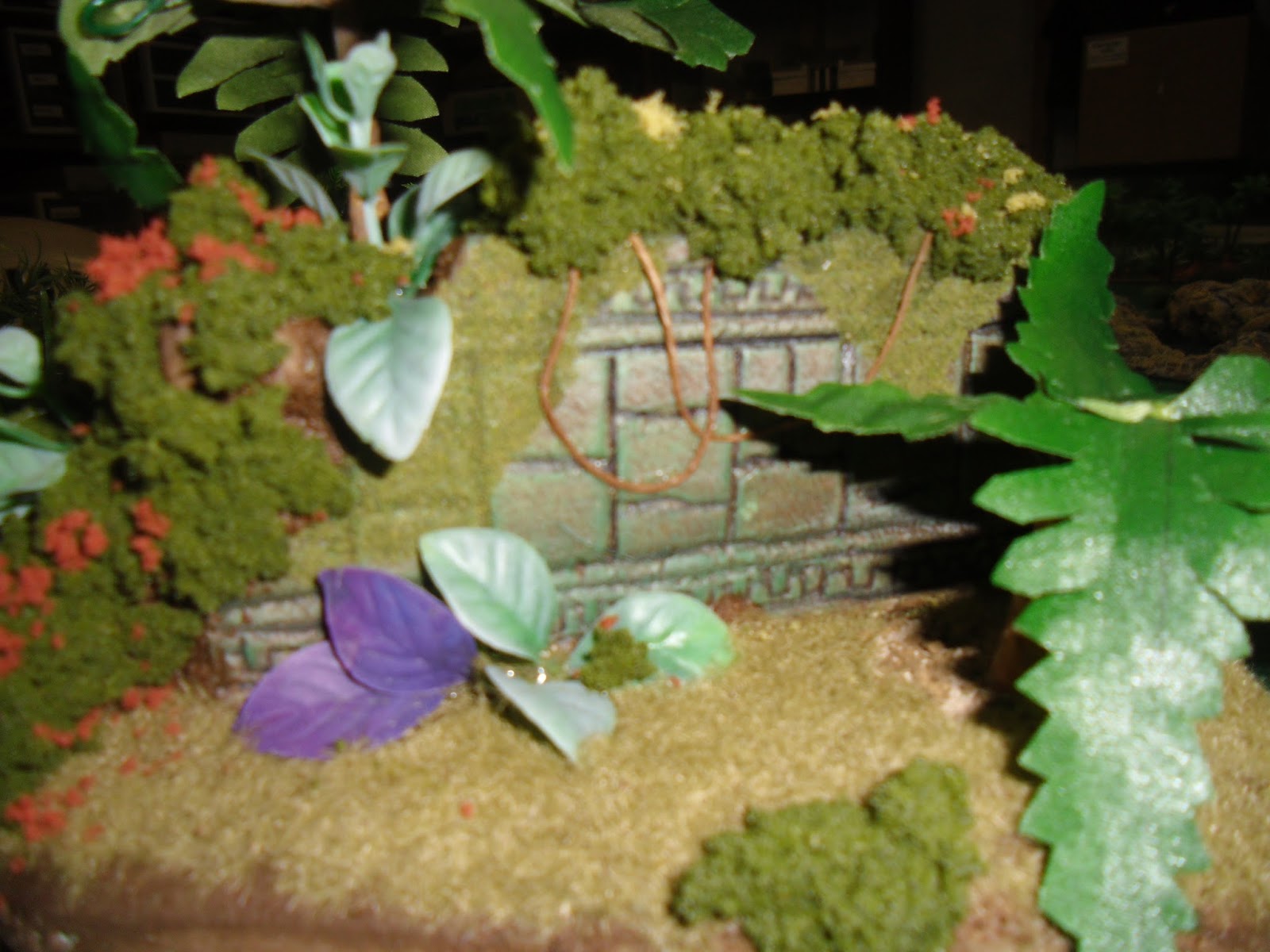
 Ruined wall from a lost civilization peeks out from the encroaching jungle
The game requires only a few dozen figures and is very much focused on the exploits of the main characters. The style of play is Pulp rather than the massed rifle fire of European regulars against plucky but technology deficient natives. What Congo natives lack in technology they make up for with sorcery.
Sanders of the River is the first white man to view the Valley of Kong
I should mention the really cool terrain pieces in this posting were created by local artist Mike Covell, AKA the King of St Maurice. I have no artistic talent myself, but the next best thing is to know someone who does.
Religious totem of a forgotten people is slowly reclaimed by the jungle
Being the flawed individual that I am, I have collected far more figures than I need. My European column has an intrepid explorer, retired military man, experienced native guide, group of three old African hands and native porters, all Copplestone and Foundary figures. The column is protected by tough, disreputable Ruga Ruga mercenaries which I converted from Warlord Games Natal Native Contingent. The Forest Tribe is made from Warlord Games Zulu unmarried warriors re-equipped with rectangular wicker shields. The Wargames Factory Zulus provide the African Kingdom warriors. I also have some Wargames Factory Amazon warriors just in case my explorer stumbles across that lost civilization.
 African Kingdom warriors
Our local group of gamers are currently working on learning the mechanics of the game, which are new and innovative. Actions are dictated by cards, some of which can be chosen each turn and others drawn randomly. In addition to the usual Move, Shoot, Melee, Morale there are also opportunities to increase stress on opponents and reduce it on friends. Native witch doctors can use sorcery to foil their enemies or perhaps anger their gods in the attempt and pay the price. My witch doctor, for example, was eaten from the inside by scorpions while attempting a particularly ambitious bit of sorcery in a recent game.
The explorers enter the lair of an impossibly large gorilla worshipped by the natives
Mike's waterfall
Gratuitous wildlife. In Congo, most of the fauna will eat you.


Thursday, September 15, 2016

Drums Along the Fingerlakes

The rebellion of the American colonials against King George is well underway. His Majesty's loyal allies, the Iroquois are raiding all along the frontier. This is the story of the attack on Fort Donald.

Just as the harvest time was upon them, the settlers of Hilton on the New York frontier heard that the Iroquois warband of Joseph Brandt was headed their way. They sent their women, children and the infirm down river to safety, and then the militia moved into Fort Donald and prepared for the fight.

 The militiamen take up position in the fort 
 At first light the Indians emerge from the forest
One side of the fort was on a steep bluff above the river and was safe from direct assault. The dozen militiamen were spread thin along the other three sides of the fort and the corner bastions. The warriors approached in three bands, one against each of the exposed sides of Fort Donald. As they raised their blood chilling war cry and began to sprint across the clear ground, the muskets of the defenders banged out in defiance.
The militiamen open fire in the uncertain dawn light
A few Indians fell crossing the open ground
The morning mist made the fire of the defenders perhaps less effective than it might otherwise be, but still five braves were killed and a similar number wounded by the time they reached the walls.
The Indians reach the walls with ladders and a ram
The two militiamen deployed along the ravine side of the fort ran to join the defenders on the three sides under attack while the British agent-provocateur, known to the Iroquois as Dances With French Fries, urged the warriors on with promises of rich gifts from King George.
Dances With French Fries shouts encouragement from just beyond musket range
The hardened warriors were soon on the parapets engaged in a desperate hand to hand struggle with the defenders while the battering ram pounded the gate.
The gates shivered with each strike of the ram
One of the Indians dropped down to the parade ground and sprinted to unbar the gate from the inside. Two of the militiamen had been killed and two others, grievously wounded, were in the hands of the savages. The remaining defenders could hear their cries as their captors handled them brutally. All of this was too much and the defenders morale broke. They agreed to lay down their arms when Dances With French Fries offered them the protection of King George. Fort Donald was comprehensively looted and the Indian war party went on to pillage and burn the deserted settlement.


Friday, August 12, 2016

Peticus Autem A Fortuna


So, the Great Man is off to Britain on a punitive expedition. Padding his resume, more like! He’s away beating up on a gaggle of bare arsed  shepherds while I’m left behind with 3 legions to keep a lid on this nest of Gallic vipers. I should have been Governor and he should be marching around these cold, rainy forests instead of torturing the Plebeians with his gutter Latin exaggerations. Well, things are as they are, and the Belgic rebel Syntax will rue the day he crossed Peticus Autem A Fortuna!

And so it was that Peticus found himself staring across a hilly, forested field at the barbaric horde of Syntax of the Belgii. The Romans deployed Legio VII on their left, Legio VIII in the center and Legio IX on the right. The barbarians were arrayed with their warriors in the center and a large body of horse on either flank.

                                                       Initial Roman deployment
 
The broken terrain made it difficult for the Romans to keep their legions aligned, and a good part of Legio VII soon found itself surrounded and fighting for its life. They faced out in all directions and fought back manfully until at last the barbarian commanding in this part of the field decided to lead the charge to break them once and for all. He and his Companions rode their chargers into the midst of the desperate legionaries, and…….died.  The barbarians were taken aback by this turn of events and, just then the rest of Legio VII came up and immediately went into the attack. The barbarians on this wing broke and, aside from a few scattered bands, were swept from the field.

                                                    Legio VII awaits the word to advance 
                                      Advance elements of Legio VII attacked from all sides
                                                   Legio VII breaks the barbarian right
                                                        Barbarian right flees the field
On the Roman right Legio IX adopted a defensive posture to avoid their formation being broken up in the rough terrain. Their opponents did the same, being reluctant to meet the Romans on the level ground.

 
                                                      Legio IX on the right flank in a standoff

In the center the barbarian leader Syntax led his men in an all out frontal assault against Legio VIII, After desperate fighting , most of the Romans broke and ran, while remnants too proud to flee delayed the pursuit.

                            Peticus views the Barbarian onslaught in the center with concern
                       Syntax breaks the Roman Legio VIII in the center with a wild charge 
On the Roman left, the victorious Legio VII reformed and began marching toward the barbarian center. Seeing the crisis of the battle had arrived the Roman right and their barbarian opponents fell on each other. After a desperate struggle the Romans prevailed. Syntax, seeing both of his flanks  collapse, pressed his pursuit of the unlucky VIIIth and so left the stricken field, to fight again another day.
                                        After a confused melee Legio IX wins on the right

 
                               Legio VII reforms and moves to envelop the barbarian center


Sunday, August 7, 2016

A simple real estate transaction


This is Good E. Tewshooze reporting for the BBC on the conflict raging in the Middle African Republic. As our viewers will recall, the problem arose several months ago when the government of the country implemented policies seen as oppressive by an eccentric splinter group, the Moslems for Jesus (MFJ). That minority was in possession of the richest farmland in the country, and their leader, the Mahdi,  declared the independence of their region.

 The national army was in no condition to move on the breakaway region but the President of the MAR had another solution ready to hand. For some time he had been in negotiations with the HAWGs (Honorable Association of White Guys), a group of white South African farmers interested in resettling as a community in the MAR.  The President agreed to sign over the lands of the Moslem rebels to the HAWGs if the immigrants could capture the land from the current owners and live there as loyal citizens of the MAR.

"Mad Mike", Commandant of the HAWGs plans his campaign
 On arrival the HAWGs were issued what military equipment the government could spare; A pair of rusty M48 tanks,  an ancient DC3 transport plane, three Panhard armored cars with big guns, assorted jeeps and trucks and small arms. Within a few weeks the newcomers had this motley assortment of weapons in working condition and were ready to move. Their force was organized into 5 companies, Tanks, Panhards, Jeeps with MG, and two infantry. The DC3 was equipped with homemade high explosive barrel bombs.
The defenders of the northern hamlet prepare for action

The Mahdi knew of the government plan and he had not been idle. Those of his people with military training were organized into an infantry company with truck transport. The rest of the male population was organized into four militia companies of infantry, each supported by a technical with AA gun and another with a heavy machine gun.
The Mahdi commands his forces from the central hamlet

The stage was set, the U.N. talked and did nothing. The MAR was of no strategic interest to any of the Great Powers, and so the tragedy played out. At dawn on the 6th of August the HAWGs advance elements of Panhards and infantry moved into MFJ territory. This part of the valley was watered by a pair of rivers, very low at this season. Three hamlets and the MFJ training camp were the major points of interest. Three MFJ militia companies were stationed there, one in the northern hamlet, one in the hamlet in the center of the valley and one in the military camp in the south.
Fort Zinderneuf, the MFJ training camp

The Panhards started shelling the northern hamlet and soon, what sounded like a flying washing machine but was, in fact, the DC3, appeared overhead and dropped a barrel bomb on the defenders. This was all too much for the defenders who started falling back in some disorder toward the central hamlet.
The militia flees the northern hamlet

The HAWG tanks followed on, rolling down the road toward the northern hamlet. Our BBC news crew, determined to expose the use by the central government of these mercenaries, blocked the advancing Panhards and exposed the unit commander to a scathing interview. This allowed the retreating militia to escape, but sadly the unit disintegrated during the retreat and was out of the fight.
Courageous journalists, armed only with cameras confront the HAWGs

The trio of HAWG armed jeeps entered the fray to the East and passed through the eastern hamlet without opposition. At the same time the BBC news crew had moved onto the road between the advancing HAWG tanks and the northern hamlet and brought the tanks to a halt with another withering expose’. The Panhards on the left were slowed to a crawl as they found themselves in a mine field. For the rest of the battle they proceeded with great caution to avoid losing any vehicles.
Gratuitous wildlife

The HAWG armed jeeps crossed to the southern bank of the river and encountered MFJ Regulars and militia advancing from the East. A savage firefight ensued in which the HAWGs lost two of their three vehicles but caused so many casualties among the MFJ that they, as well as the HAWGs were rendered combat ineffective. One of the HAWG infantry units, led by Mad Mike, was able to cross the river in this part of the field and helped to see off the remnants of the two MFJ units that had engaged the jeeps.
Hawgs force the river crossing against heavy opposition

 The DC3 made a pass over the central hamlet where the Mahdi was posted and dropped a barrel bomb on the militia unit there. At the same time the Panhards had managed (in spite of the mine field) to get into position to open fire on the central village. The commander of the HAWG tanks had finally abruptly ended the BBC interference  with his mission and was advancing on the central hamlet.  All of this was too much for the garrison, which withdrew in disorder to the south, toward the military camp. The garrison of the camp began moving up the road toward the fighting. The last of the HAWG units occupied the northern hamlet. The Mahdi surveyed the wreckage of his army and decided to withdraw from the field to reorganize, rearm and fight another day.    
The stricken field


Sunday, July 31, 2016

Up the Great Gray Greasy Zambesi

Trouble in the interior.....again. The Arab slavers and their tribal allies, the uWanna have resumed raiding the peaceful tribes near our coaling station at the mouth of the Zambesi river. A small expedition upriver to burn a uWanna village and take some cattle should serve to restore order.
                     The Governor decided to punish the natives and would not be gainsaid!
So it was that Captain Poulet found himself disembarking from a decrepit paddle steamer deep in the territory of the fierce uWanna. He led his company of about 50 Marines, a handful of sailors from the boat and a gatling gun. Hauling the gatling might slow him down a bit but it would come in handy if he met resistance. The key would be to strike quickly and get out before the tribesmen had a chance to gather.
                      The heat! The insects! Let's get this over with and return to the coast.
The heat was oppressive as the small expedition made its way inland. They were not halfway to the target village when they spotted Arabs advancing on them in the distance. The slavers had their spies watching the coast and had decided to interfere. They must be hoping to link up with the uWanna warriors to oppose the incursion. Cursing his luck, Poulet directed his small column toward a position where he could see off the rabble of slavers armed with swords, spears and a few ancient muskets.
                                                    Damned slavers, how came they here?!
As the Marines jogged into position on the ground Poulet had chosen, he ran an eye over the site. Yes, this would do very well. A stream to his front would slow the attackers. To his right an impassable ravine, His left and rear were somewhat exposed but his Bluecoats would hold, come what may.
                                          A good position, clear field of fire. Let them come!
Just as he began directing his men into position, a Lieutenant called to Poulet and directed his attention off to his left. In the distance he could see a large number of uWanna warriors moving rapidly to envelop him and cut off his retreat to the river. This was starting to look like a proper battle! For just a moment Poulet remembered the stories of the terrible things done to the rare European who had the misfortune to fall into their hands. Shaking off the thought, he returned to the business of deploying his men.
                  The uWanna Chieftain known to the Europeans as 'Pete' makes his dispositions
Poulet had planned to form a line along the bank of the stream and direct all of his considerable firepower against the Arabs advancing slowly toward his front. The arrival of the fast moving, aggressive uWannas on the field had changed everything. Now he was cut off from the riverboat with enemies on three sides. He quickly changed his dispositions, setting his back to the ravine and positioning his rifles and gatling gun in a three sided "square". Everything now depended on the steadiness of his Marines and the awful stopping power of their breech loading rifles.
                                                                     Form Square!
The Marines had seen action before but they couldn't help but feel apprehensive at the swiftness and discipline with which the uWanna warriors formed up. On the other side of their position the Arab leaders seemed to be having some difficulty preparing their men for the attack.
                                                             The lull before the storm
The white men and their enemies stood in their ranks in silence for what was probably just a few minutes, but seemed much longer. At last the silence was broken by the uWanna chief who called out the order to advance, which was repeated by his several sub chiefs. The warriors jogged forward on two sides of the square, chanting their war song. On the third side the Arab leaders were doing all they could to move their men against the Marines, but those men knew better than the tribesmen the power of the white mans weapons.  
                                               The tribal wave breaks on the wall of fire
At a word of command from their Chief, the uWanna warriors gave a great shout and broke into a run. The commands Present...Fire! were barked out along the line of bluecoats and the terrible volleys crashed out, blending with the chatter of the Gatling. The bullets tore great bloody holes in the ranks of the charging warriors. In a few places, knots of warriors managed to close with the enemy only to be cut down by the steady line of Marines. For most of the natives the fire was more than flesh and blood could bear. The charge faltered, stopped and then fell back, step by step still facing the enemy. Their Arab allies had failed to charge at all, and that account would be settled in time. Poulet, seeing the enemy withdraw, ordered the cease fire. The Marines waited in their position until mid day. It was clear the enemy had withdrawn and Poulet had just enough time to burn a nearby village and get back to the river by dark.